


●Information for
Scientific Conferences
The 26th activities
8th: Gifu ご案内
 Report
7th: Hokkaido ご案内Report
6th: Shiga ご案内Report
5th: Yamgata ご案内Report
4th: Kagawa ご案内Report
3rd: Fukui ご案内Report
2nd: Hokkaido ご案内Report
1st: Oita ご案内Report
●about URSI ●Present activities
- 26th: 2024.4 - 2027.3
Radio Science Bulletin by www.ursi.org
National Science Report CDROM
●Uploader
Library
●Mailing List
Scientific Conference InfoMail
●Related links
Domestic International
●BBS
Member's BBS
The seventh scientific workshop
presented by the 26th URSI-C in Japan
presented by the 26th URSI-C in Japan
Session title:
"Simulation Technologies for Antenna and Propagation Systems
Looking Ahead to 6G/7G"
1. Reporter: Takuji Arima, Member of the URSI-C Sub-Committee, Science Council of Japan (Tokyo University of Agriculture and Technology)
2. Date/time: Friday, January 9, 2026, 13:30 - 16:30
3. Venue: Jozankei View Hotel, Conference Room
2-Chome Jozankei Onsen Higashi, Minami-ku, Sapporo, Hokkaido 061-2302, Japan
Held in a hybrid format (In-person and Online)
4. Registration fee: Free
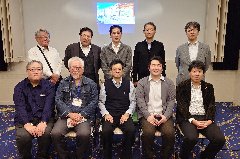
5. Listed attendees: 28 total (12 in-person, 16 online)
6. Local arrangement: Takuji Arima (Tokyo University of Agriculture and Technology)
7. Research Theme: "Simulation Technologies for Antenna and Propagation Systems Looking Ahead to 6G/7G"
8. Presentations:
- 13:50 - 14:00 Opening Remarks
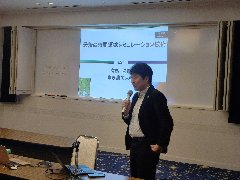
Dr. Fujimoto, Chair (Fukui University)
- 14:00 - 14:40 "Biological Simulation Technology"
Takashi Hikage (Hokkaido University)
- 14:40 - 15:20 "Latest Time-Domain Simulation Technologies"
Takuji Arima (Tokyo University of Agriculture and Technology)
- 15:20 - 15:30 Coffee Break (10 min.)
- 15:30 - 16:10 "Channel Knowledge Map Generation via Graph Representation Learning"
Katsuya Suto (Hokkaido University)
- 16:10Closing
9. Social gathering:
It was held from 18:00 to 20:00 at Jozankei View Hotel. Participants was 18.
10.Other Activities:
The Executive Committee meeting was held on Saturday, January 10, from 8:00 to 9:00 at the Jozankei View Hotel.
11. Impressions
Systems for 6G and 7G are currently under active consideration. In 6G, the utilization of millimeter-wave and terahertz bands is expected to achieve communication speeds that surpass the limitations of current 5G networks. Furthermore, the 6G era brings high expectations for ISAC (Integrated Sensing and Communication), which integrates environment sensing and data collection capabilities alongside standard communication functions. Against this backdrop, the 27th Term, 7th Open Workshop was held to focus on simulation technologies for antenna and propagation systems, as well as their related technologies, looking ahead to 6G/7G. This workshop featured three presentations addressing the technologies to realize these advancements, specifically focusing on simulation techniques from the perspective of antennas and propagation.
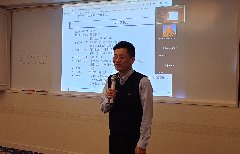
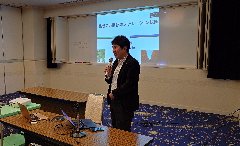
In the presentation by Prof. Hikage (Hokkaido University), biological simulation technologies geared toward 6G/7G were discussed. Currently, the use of electromagnetic waves in close proximity to the human body is advancing rapidly. Consequently, it is necessary to quantify the amount of electromagnetic energy absorbed when a portion of these waves enters the human body. This presentation introduced methods to quantify electromagnetic absorption across various scenarios anticipated in 6G/7G. The content was highly engaging and sparked an active Q&A session.
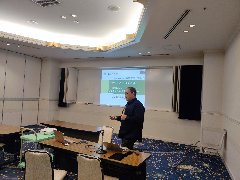
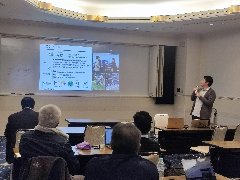
The presentation by Prof. Arima (Tokyo University of Agriculture and Technology) introduced electromagnetic analysis techniques tailored for 6G/7G. Electromagnetic analysis is indispensable for developing various technologies in the 6G/7G era. This presentation introduced the FDTD (Finite-Difference Time-Domain) method, which allows for the straightforward analysis of complex models. In particular, it covered simulation technologies for moving objects, such as V2V (Vehicle-to-Vehicle) communications, as well as large-scale simulation techniques required for the massive models expected in 6G/7G.
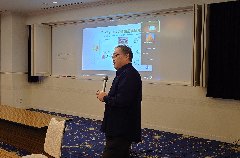
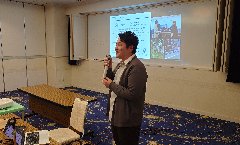
The presentation by Prof. Suto (Hokkaido University) addressed analysis methods for propagation models looking ahead to 6G/7G. This talk explained how machine learning can be used to find fast, highly accurate solutions for models that traditionally required substantial simulation time. He highlighted that accuracy can be further improved by utilizing various learning models, which was deeply interesting. The lecture also covered the application of quantum computing?one of the key phrases in Beyond 5G and 6G?to the wireless communications field, and was followed by a vibrant discussion.
In conclusion, it was highly beneficial to have a broad and productive discussion on simulation technologies for 6G/7G from the critical perspectives of antennas and propagation.
 |
 |  |
 |  |
 |  |
 |
To view larger photo, please click above photo then type password.