


The nineth scientific workshop
presented by the 26th URSI-C in Japan
presented by the 26th URSI-C in Japan
Session title:
"New Developments in Wireless Communication Signal Processing and Electromagnetic Wave Technologies
--- From Millimeter-Wave and Sub-Terahertz Bands to Next-Generation Applications ---"
1. Convener: Prof. Kensuke Okubo (Okayama Prefectural University)
2. Date/time: Oct. 2nd, 2026 / 14:10 - 17:10
3. Venue: Meeting Room 1, Shimanto City Cultural Center "Shimantopia"
(Uyamasatsukicho, Shimanto city, Kochi pref.)
(Hybrid conference with web conference)
4. Registration fee: Free
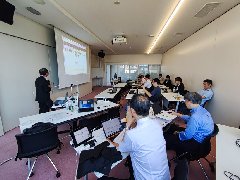
5. Listed attendees: 17 persons,Online: 3 persons
6. Technical arrangement: Prof. Kensuke Okubo (Okayama Prefectural University)
7. Local arrangement: Dr. Junji Sato (Panasonic Corp.)
8. Session title: "New Developments in Wireless Communication Signal Processing and Electromagnetic Wave Technologies --- From Millimeter-Wave and Sub-Terahertz Bands to Next-Generation Applications ---"
9. Presentations:
- 14:10 - 14:15 Opening Remarks
Prof. Mitoshi Fujimoto, Chair, Commission C of URSI-JNC
(University of Fukui)
- 14:15 - 14:55 "Development of Wireless Communication Modules from Millimeter-Wave to
Sub-Terahertz Bands"
Dr. Kaoru Sudo (Murata Manufacturing Co., Ltd.)
- 14:55 - 15:35 "An Overview of Research on High-Frequency Functional Devices Using
Liquid Crystals"
Dr. Takao Kuki
- 15:35 - 15:45 Coffee Break (10 min.)
- 15:45 - 16:25 "Potential of LoS-MIMO for Underwater Electromagnetic Communications:
Antenna Array Design Based on Channel Capacity Analysis"
Prof. Miyuki Hirose (Kyushu Institute of Technology)
- 16:25 - 17:05 "Analog Two-Port Networks and Group Theory"
Prof. Emeritus Takashi Ohira (Fujiwaves Co. Ltd., Toyohashi University of
Technology)- 17:05 - 17:10 Closing
- 19:30 - 21:00 Reception
- 21:10 - 21:45 Evening session "Editing Technical Articles to Bring Specialized Technologies
Closer to Readers"
Ms. Ayako Araya (CQ Publishing Co., Ltd.) - 17:05 - 17:10 Closing
10. Reception:
It held from 19:30 to 21:00 at New Royal Hotel Shimanto in Nakamurakoshomachi, Shimanto, Kochi. The number of attendees was 15.
11.The Steering committee meeting:
It took place from 8:30 to 9:30 on Oct. 3rd, 2026, at New Royal Hotel Shimanto.
12. Concluding Remarks
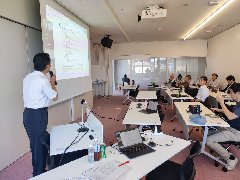
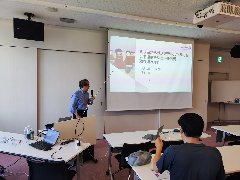
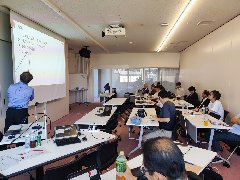
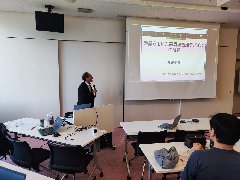
As research and development of next-generation wireless communication technologies for millimeter-wave and sub-terahertz bands continue to accelerate, a high degree of integration among antennas, circuits, materials, devices, and signal-processing technologies is becoming increasingly important. At the same time, applications of electromagnetic wave technologies are expanding beyond conventional wireless communications into emerging fields such as underwater communications and novel functional devices. Under the theme of "New Developments in Wireless Communication Signal Processing and Electromagnetic Wave Technologies --- From Millimeter-Wave and Sub-Terahertz Bands to Next-Generation Applications ---", this workshop presented recent research achievements from diverse perspectives, ranging from device technologies and communication theory to the fundamentals of electromagnetic circuit theory, and stimulated active discussions among the participants.
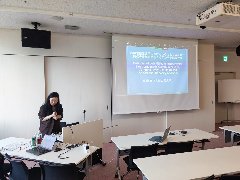
Dr. Kaoru Sudo (Murata Manufacturing Co., Ltd.) presented antenna-integrated modules (AiMs) and packaging technologies that support the realization of high-frequency wireless communications for Beyond 5G and 6G systems. He introduced the configuration of millimeter-wave AiMs and examples of related technological developments, followed by a discussion of the challenges and ongoing efforts toward extending operation into the sub-terahertz band, particularly around 140 GHz. He also described low-loss substrate materials and their transmission characteristics, as well as dielectric characterization techniques for evaluating relative permittivity and loss tangent up to 300 GHz. The presentation highlighted the importance of packaging and materials technologies for future wireless communication systems.
Dr. Takao Kuki presented his research on high-frequency functional devices using liquid crystals. He introduced the concept of using liquid crystals as the dielectric material in high-frequency devices as a means of controlling high-frequency signals and radio waves. He then explained the results of measurements of the dielectric properties of liquid crystals at high frequencies, as well as the fabrication and evaluation of prototype variable delay lines and tunable radio-wave lenses. Although this research on high-frequency applications of liquid crystals was conducted more than 20 years ago, he also noted that it has recently regained attention as a technology for next-generation wireless communications.
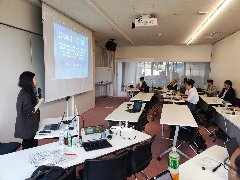
Prof. Miyuki Hirose (Kyushu Institute of Technology) presented research on LoS-MIMO antenna arrangements for underwater electromagnetic communications from the viewpoint of channel capacity. Various antenna element configurations were compared, and the UXA configuration was shown to provide stable and high communication capacity. The analysis was further extended to a propagation-loss model incorporating the complex propagation constant of seawater, and the effects of channel correlation and transmission loss were evaluated. In addition, Monte Carlo simulations under dynamic conditions demonstrated the existence of an optimal array aperture and clarified the relationship between the optimal carrier frequency and communication distance.
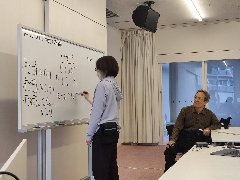
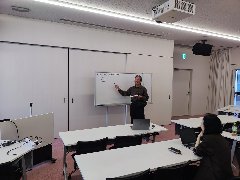
Professor Emeritus Takashi Ohira (Fujiwaves Co. Ltd., Toyohashi University of Technology) carried out an interactive whiteboard lesson on the world of resonant LC progression. Even though the single unit of LC is so simple and well known, the cascade connection makes difference. While the network grows endlessly, it is like magic that the resonance leads the F-matrix to a regenerative cycle with a finite period. A derived circular chart elucidates the network’s recurrent behavior discovering the thru, gyrator, and inverter functions as well as the inverse relationship among the circle members.
All presentations covered a broad range of topics, from enabling technologies for millimeter-wave and sub-terahertz wireless communications to novel electromagnetic wave applications and fundamental theories. The workshop provided a valuable opportunity for participants to deepen their understanding of the technical challenges and future directions of next-generation wireless communication systems and electromagnetic wave technologies. It is hoped that the knowledge shared through this workshop will stimulate further research collaboration and technological innovation in these rapidly evolving fields.
 |
 |  |
 |  |
 |  |
 |  |
 |  |
To view larger photo, please click above photo then type password.